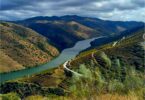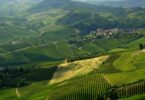



High above the sun-drenched French Riviera, perched on the rugged western slopes overlooking the city of Nice, lies one of France’s most hidden and distinct viticultural treasures: the vineyards of Bellet.
Wedged between the Mediterranean Sea and the Alps, winemaking is a stubborn preservation of heritage, and a tribute to an extraordinary microclimate that has shaped the region for centuries.
A Radical Geography
Situated at an average altitude of 200 to 300 meters, the appellation’s hills run predominantly north-south, cradled between the Var river valley to the west and the Magnan valley to the east. The terrain is defined by wild reliefs and slopes so precipitously steep that traditional viticulture is entirely impossible.
The vines cannot be planted in sweeping, tractor-friendly rows. Instead, they are coaxed into existence on cramped restanques, narrow, ancient stone-walled terraces, often holding a maximum of just six rows of planting. The paths winding through these high-altitude plots are narrow, averaging a mere 1.70 meters in width, allowing little more than the occasional compact tilling vehicle. With plants spaced less than a meter apart, the vast majority of vineyard maintenance must be performed entirely by hand.
Compounding the logistical hurdles of the terrain is a rooted family scattering of heritages, resulting in a fragmented patchwork of smallholdings. Interspersed amongst suburban villas and greenhouses dedicated to growing cut flowers, some fifteen family estates and numerous small plots make up the appellation. While the A.O.P. Bellet technically spans a geographical footprint of some 650 hectares, only about 70 hectares are actually under vine.
This extreme geography severely limits mechanization, making human labor an omnipresent, vital force in the life of Bellet. The harvest, which traditionally takes place around the end of September, is entirely manual, governed by a strict legal yield limit of 40 hectoliters per hectare. Only a handful of domains, around half a dozen in recent decades, are large enough to support full-time agricultural workforces.
The Breath of Sea and Mountain
The unique sensory profile of Bellet wines is written in its soils and air. Geologically, the region shares its foundation with the vast gravel beds carved out by the Var river and its alpine tributaries. The soil is a sedimentary mosaic of sand-lime compositions and Pliocene rolled pebbles (galets), compacted together with streaks of clay to form a distinct rock known locally as poudingue.
Above ground, the vineyards experience a climate of striking contrasts. Bathed in a generous 2,700 hours of sunshine per year and receiving an annual rainfall of 838 millimeters, the climate is fundamentally Mediterranean. Yet, the ambient heat is continually tempered by a dramatic dialogue of winds: sea breezes sweeping up from the Var valley meet crisp, cool alpine winds descending from the North.
This meeting of elements creates massive diurnal temperature variations. Warm sunny days give way to brisk, cooling nights—a phenomenon that has long protected Bellet’s white wines from the premature oxidation that often plagues other southern wine regions. The hills themselves are a patchwork of varied exposures; some slopes bask in the full, southern Mediterranean sun, others face the cooler northern alpine winds, while others still greet the rising or setting sun at shifting altitudes.

© Ph. Bellet- Vin de France
The character of Bellet is anchored in its distinct selection of grape varieties, which span crisp whites, delicate rosés, and structured reds.
The white A.O.P. Bellet wines find their soul in the Rolle (locally known as Vermentino), a grape celebrated for contributing exquisite floral aromas. While some winemakers incorporate a small touch of Chardonnay and occasionally late-harvested Clairette from old plots for a fruitier edge, Rolle remains the undisputed monarch of the white portfolio. Historically, white wine was the principal style produced in Bellet, earning widespread acclaim for its freshness and resilience against oxidation.
The appellation’s rosé wines are crafted from a blend of three grapes, prominently featuring Braquet, a native black variety named after an old local family. Fragrant and delicate in both taste and constitution, Braquet provides the finesse, body, and color that define Bellet rosés, alongside Mediterranean staples Grenache and Cinsault. In times past, Braquet dominated blends to such an extent that bottles proudly bore the name “Braquet-Bellet.” Today, strict regulations keep the residual sugar in Bellet rosé capped at a maximum of 3g/l—a notably lower limit than neighboring Provence.
For the red A.O.P. Bellet wines, winemakers draw upon a quartet of varieties: two locals (Folle Noire and Braquet) and two Mediterranean transplants (Grenache and Cinsault). Folle Noire, with its intensely dark berries that turn pitch black by mid-August, supplies the reds with robust tannin, body, and deep color. Winemakers typically spotlight Folle Noire by rounding it out with Cinsault, Grenache, and a touch of Braquet, while Grenache lends its classic Mediterranean warmth to the blend.
Over the decades, the production ratio has steadily evolved. While white wine once reigned supreme, production has grown more evenly distributed across all three colors, with rosé capturing roughly a quarter of total output by the late 2000s. Winemaking standards remain uncompromising; chaptalization is strictly forbidden, and historical alcohol levels hover modestly around 10.5% for reds and rosés, and 11% for whites.
A Storied History and Neighborhoods of Character
The formal recognition of Bellet as an appellation is a relatively modern triumph born of dedication and foresight. In 1941, Pierre Thomé of the Château de Crémat—serving as president of the Syndicat of the Vignerons of Bellet—joined forces with the Baron de Charnacé to successfully establish the A.O.P. Bellet, securing its place in France’s viticultural pantheon.
The region’s community of vignerons has always been tight-knit. In 1986, records showed 21 registered grape growers, though only 7 actually vinified their own wine on-site. Today, the names of Bellet’s historic neighborhoods resonate through its estates: Les Séoules, Le Pilon, Le Grand Bois, Golfan, Les Cappans, Saint Roman de Bellet, La Tour, Candau, Saquier, Serre-Long, Crémat, Cantagalet, La Pouncia, Saint-Saveur, and Gros Pins.
From the southern outposts like Collet de Bovis, Domaine de Toasc, Domaine St Jean, Château de Crémat, and Clos Nicea; to the eastern slopes home to Le Clos St Vincent and Via Julia-Augusta; to the western pathways of Chemin de Saquier featuring Domaine de Vinceline, Domaine de la Source, and Max Gilli; up to the northern reaches anchored by the historic Château de Bellet and Coteaux de Bellet—each estate tells a story of perseverance against the odds.
Preserving a Rare Legacy
Protected by history, driven by a commitment to manual craftsmanship, and blessed by a climate shaped by sea and mountain, Bellet remains a defiant celebration of terroir. Here, every bottle carries the essence of steep stone terraces, the cool breath of alpine winds, and the enduring passion of families who refuse to let history fade into the valleys below.