


To understand the history of the Mediterranean, one must follow the golden trail of olive oil. For millennia, this liquid gold has been more than a dietary staple; it has been the lifeblood of commerce, ritual, and daily survival. Yet, the story of how humanity coaxed oil from the bitter olive fruit is a grand technological epic, evolving from humble household chores over primitive stone mortars to the rumbling steam engines of the industrial age.
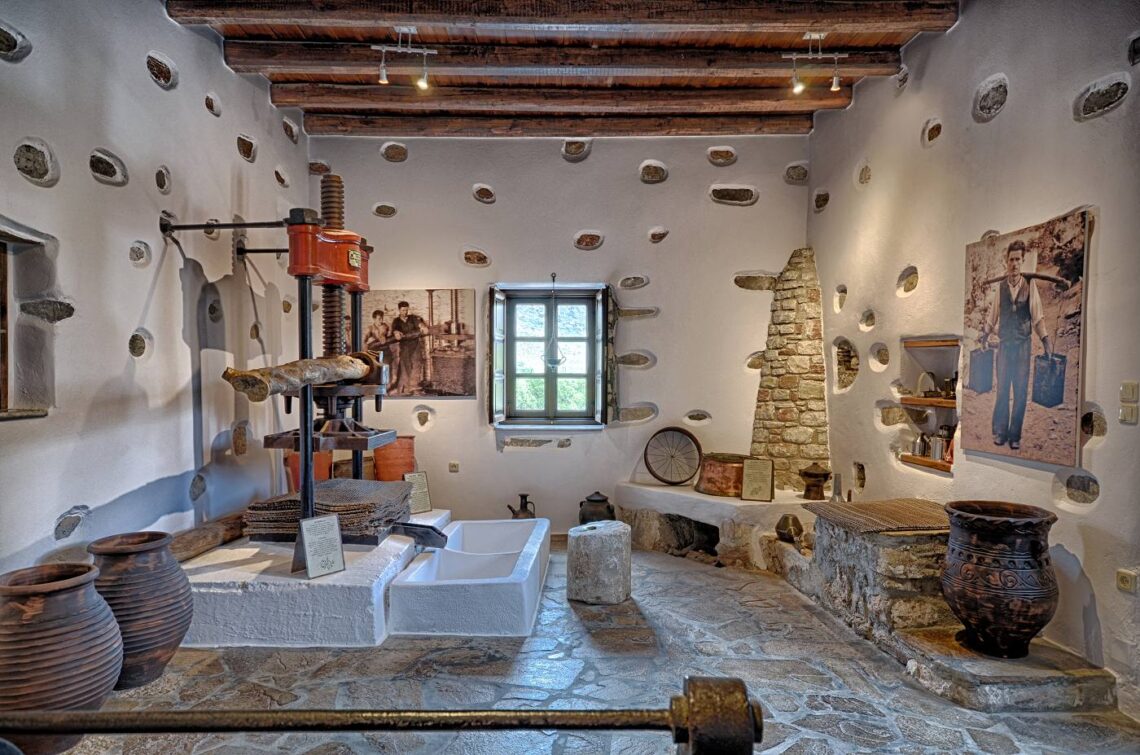
Today, visitors to the Greek island of Naxos can step directly into this rich heritage at the newly restored Eggares Olive Press, a living museum that bridges centuries of agricultural tradition with modern preservation.
© Ph. Eggares olive oil Museum
The Domestic Dawn: Household Basins and Stone Mortars
Long before the advent of sprawling agricultural factories or commercial mills, the production of olive oil was an intimate, domestic affair. In the earliest days, olive oil was produced entirely within the household. Each family assumed the responsibility of producing the exact quantity of olive oil they would need to sustain themselves through the year.
To achieve this, households relied on simple stone vessels, known as mortars. Within these modest stone bowls, the freshly harvested olive fruit was manually crushed. Once bruised, the pulp was gently heated to help release the precious oil, a rudimentary process that laid the groundwork for an industry that would eventually shape entire civilizations.
From Manual Labor to the First Mills
As populations grew and culinary demands expanded, household production proved insufficient. This necessity sparked the invention of the first formal olive mills, transitioning the craft from a kitchen chore into a communal trade.
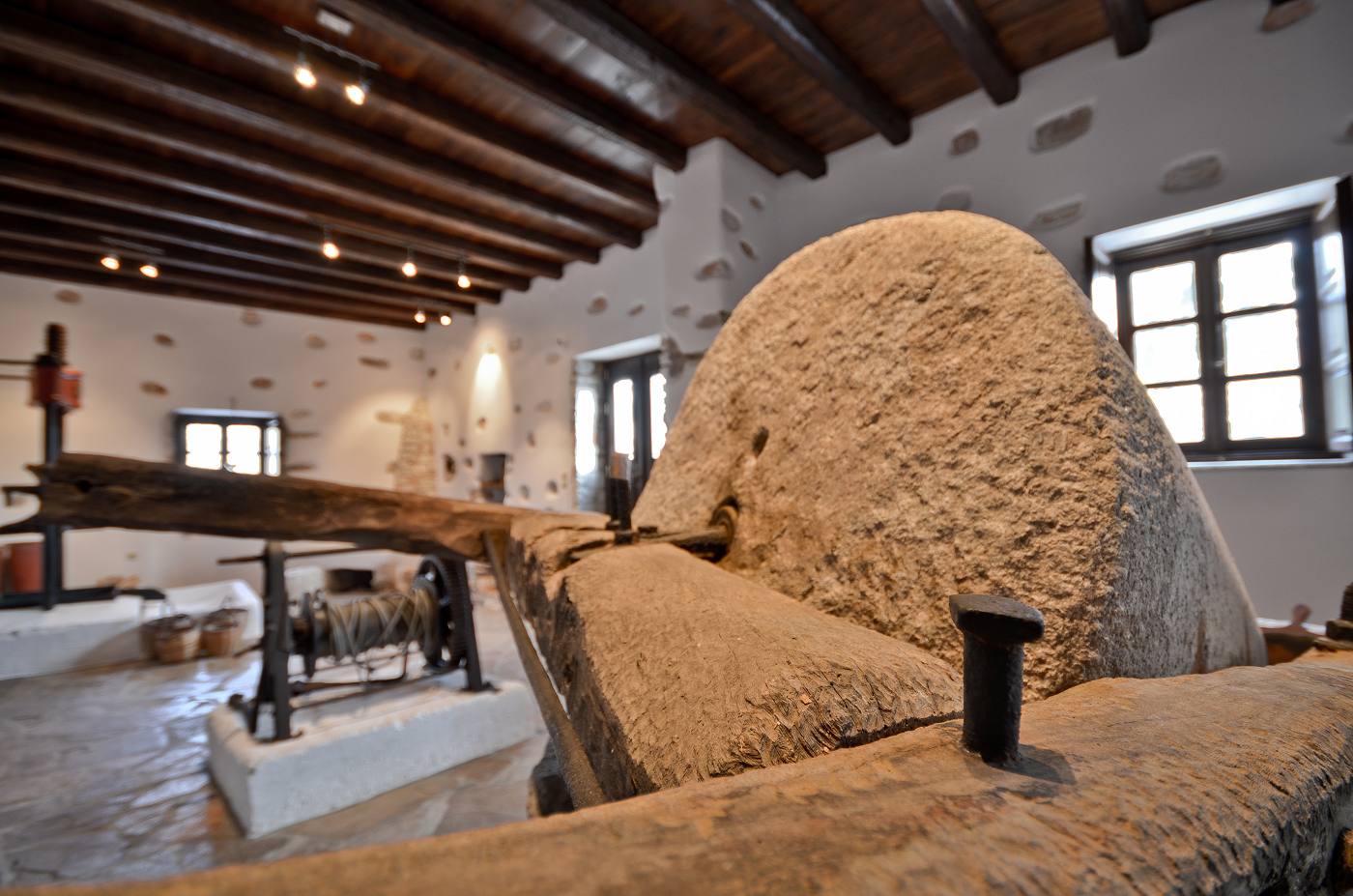
In these early mills, the olive fruit was manually crushed by placing olives onto large, flat stone plates. Pressure was then applied using a heavy, round-shaped stone rolled over the fruit. Once pulverized, the resulting olive paste was transported to separate presses.
The design of these early presses was ingenious in its simplicity. The base consisted of a large, shallow stone basin, carved into either a round or rectangular shape. Pressing was achieved by utilizing a massive stone weight placed at the end of a long wooden beam. When pulled downward, the beam exerted tremendous leverage, forcing the oil and vegetation water out of the pulp.
Classical Ingenuity and Roman Engineering
Innovation in olive oil production accelerated through antiquity. During the classical era within the Helladic area, inventors introduced the cylinder crusher, improving the efficiency of breaking down the tough olive skins and pits.
The Hellenistic period brought further refinement with the invention of the rotary mill, most notably the “trapetum.” Deriving its name from the Greek verb “trepo” (meaning “to turn”), this sophisticated mill consisted of two millstones featuring curved external surfaces. Driven by thick beams with rectangular cross-sections, these millstones rotated to grind the olive fruit with unprecedented consistency.
Following the Greeks, the Romans revolutionized the mechanics of agriculture. During the Roman era, a new type of olive mill emerged: the “mola olearia.” This machinery typically featured one or two cylinder-shaped millstones supported by a large vertical axis. Alternatively, some variants utilized a single millstone supported by a sturdy iron pile, increasing the speed and volume of production across the Roman Empire.
By the time of the Byzantine era, olive oil technology had coalesced, with both the classical “trapetum” and the Roman “mola olearia” seeing widespread, simultaneous use across the Mediterranean.
© Ph. Eggares olive oil Museum
The Industrial Revolution and the Mechanization of Greece
For centuries, the fundamental mechanics of olive mills relied on human or animal muscle. However, the 18th-century Industrial Revolution in Europe fundamentally changed the landscape of manufacturing, and agriculture was no exception.
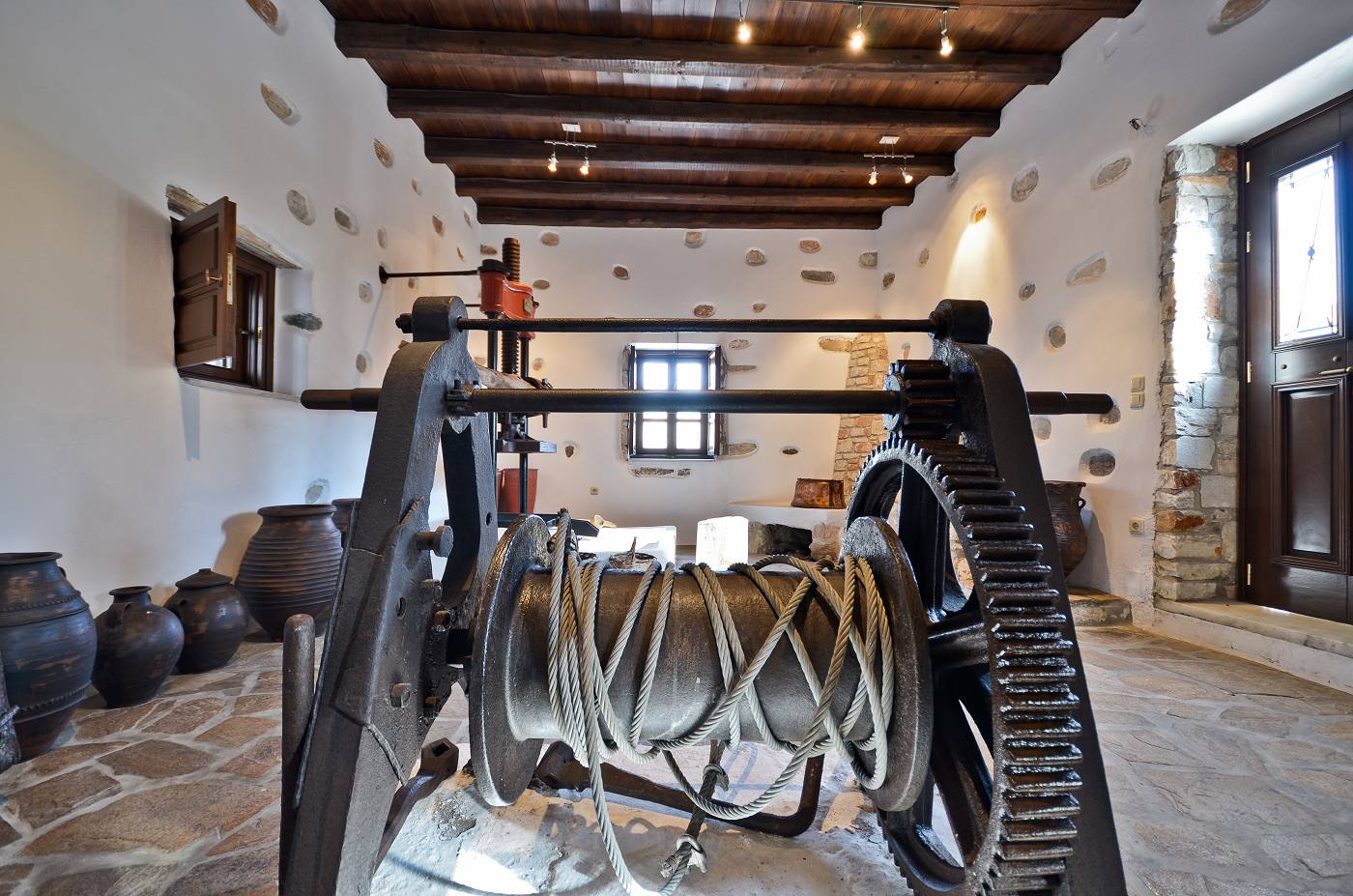
In Greece, the shift toward industrialization arrived in the late 19th century. Local olive mills began replacing traditional wooden components and animal-driven wheels with advanced machinery imported from abroad or manufactured in domestic urban centers like Piraeus.
Historians have broadly categorized traditional olive mills into four distinct technological eras:
The Pre-Industrial, Animal-Drawn Olive Mill: Predominant in Greece until around 1970, these mills utilized animal power to turn the crushing stones, though they were eventually upgraded with metal presses, winches, and other iron components.
The Pre-Industrial, Water-Powered Olive Mill: Known since the Byzantine era, these mills saw widespread adoption from the 10th century onward. Water served as the primary power source, turning a massive blade-fitted wheel. Through an intricate system of cogwheels and leather belts, the water’s kinetic energy was transferred to the millstones.
The Steam-Powered Olive Mill: Marking a massive leap in output, steam-powered mills made their debut in Greece in 1870, heralding an era of faster, high-capacity production.
The Diesel-Powered Olive Mill: Emerging in the 20th century, these advanced mills relied on diesel engines to drive their machinery. Featuring iron mill floors, harder composite millstones, and water-powered hydraulic presses, they represented the pinnacle of traditional pre-modern processing.
The Mechanics of Tradition: The “Magganos” System
Regardless of the power source,whether water, steam, or diesel, the core physics of oil extraction remained focused on separation.
A quintessential example of this is the iron press system known as the “Magganos.” In this system, the auger terminated in a flat, square piece of iron called the “tavli” (table). This plate was pressed forcefully against the “tsourapes”—specialized, durable bags woven from goat hair into which the mashed olive pulp was packed.
As the press squeezed the goat-hair bags, a mixture of vegetation water and oil flowed out. This liquid passed through a specialized collection pan known as the “lichnos.” From there, the liquids drained into settling basins, where the final, elegant separation took place using simple gravity. Because oil is naturally lighter than water, it floated gracefully to the top, ready to be skimmed off as pure, liquid gold.
© Ph. Eggares olive oil Museum
Step Back in Time: The Eggares Olive Press on Naxos
While modern centrifugal extraction plants have largely replaced these historic methods, the tangible legacy of traditional olive oil production is fiercely protected in places like Naxos.
Nestled in the village of Eggares, just 8 kilometers north and a brief 15-minute drive from bustling Naxos Town, stands the Eggares Olive Press. Dating back to at least the late 1800s, this historic site is one of the island’s oldest remaining olive mills, having once served as the beating agricultural heart of the local village community.
For generations, the press has been lovingly maintained by the Lianos family, who have owned the property for at least five generations. Recognizing the immense cultural and historical value of the site, the family recently undertook a comprehensive restoration effort. Spearheaded by the well-known civil engineer Yiannis Protonotarios, the project meticulously restored both the historic olive press machinery and the surrounding property, breathing new life into a monument of Aegean agricultural history.
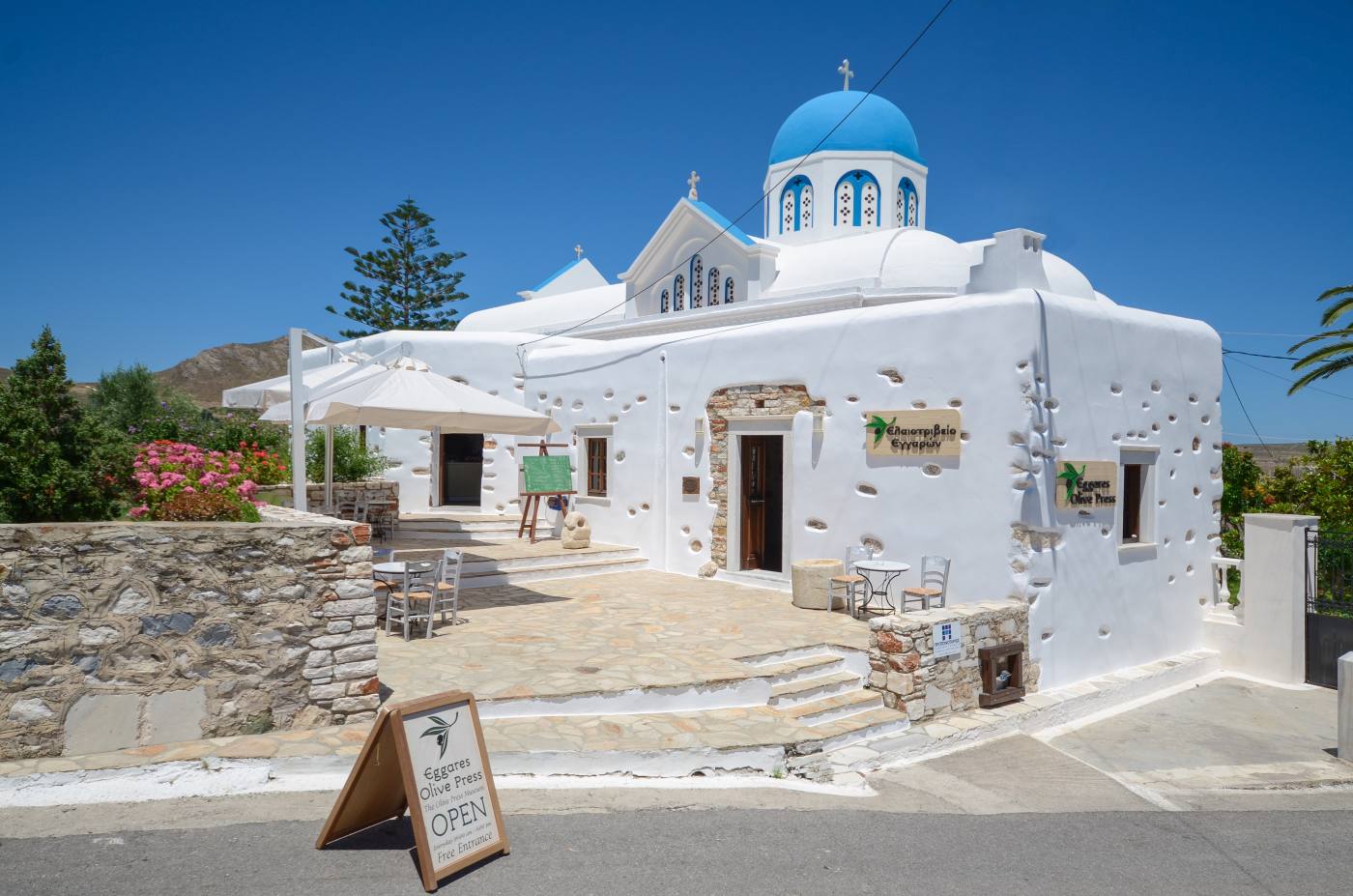
© Ph. Eggares olive oil Museum
Today, the Eggares Olive Press has been transformed into a charming, family-owned destination that seamlessly operates as a museum, café, and local shop. Visitors to the site can walk the historic stone floors, inspect the antique presses that once processed the island’s harvest, and experience firsthand the sights, smells, and stories of Naxos’s rich rural past.
As the world increasingly rushes, landmarks like the Eggares Olive Press stand as vital guardians of memory,proving that the history of olive oil is, quite literally, the history of us.