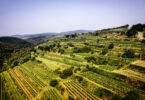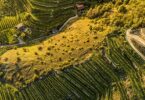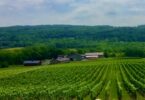



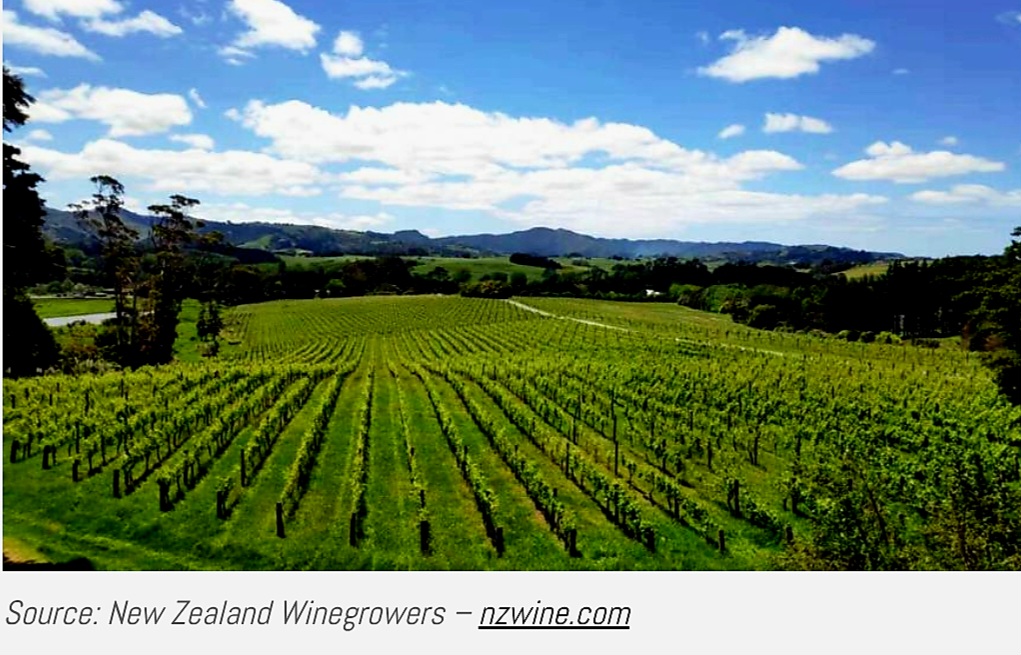
Just 45 minutes north of Auckland City’s bustling harbour bridge, the landscape shifts dramatically. The concrete and urban sprawl give way to the pretty, rolling green hills of Matakana, a stunning, picturesque destination that has quietly evolved into one of New Zealand’s most fascinating and diverse wine-touring regions.
Matakana offers a sensory feast. Nestled among vineyard accommodations that overlook sun-drenched slopes, wine enthusiasts are increasingly discovering that this coastal enclave is a serious and dynamic wine-growing frontier.
A Terroir Shaped by History and Sea
The region’s soils are a complex, patchwork mix of clays, peat loam, and sandy soils, with vineyards predominantly planted on sedimentary sandstone and greywacke clays. Adding to this unique terroir is the ghost of the region’s historic vegetation. Ancient forests of Kauri and Pātēa (Puriri) once dominated the landscape, leaving behind a legacy of varied soil nutrition and fertility.
Generally speaking, these soils boast sufficient water-holding capacity to allow vines to grow and ripen successfully without the need for artificial irrigation. Furthermore, because almost all of the region’s vineyards are planted on slopes, natural drainage is optimized, keeping the clay soils from becoming waterlogged.
Geographically, the Matakana wine-growing region sits tucked away in the northeastern corner of the Auckland region. It is effectively bounded by the sparkling expanse of the Hauraki Gulf to the east and the protective range of hills surrounding Mt. Tamahunga to the west.
This coastal positioning creates a strong maritime influence that successfully moderates temperature extremes. Summers are warm and moderate, while winters remain mild. Crucially, during the critical growing season, Matakana experiences a relatively small diurnal shift between day and night temperatures. The result? Fruit that ripens at a steady, balanced pace, yielding wines with distinct site-driven characteristics, well-balanced natural acidity, and moderate alcohol levels.
While the prevailing winds blow from the southwest, meaning the Waitākere and other western ranges help shelter Matakana from some of the heavier rainfall experienced by greater Auckland, its maritime nature remains a defining factor. Summer brings the prevalence of easterly sea breezes, making careful site selection paramount. Vintners must position their blocks to maximize sun exposure and vital airflow, which naturally decreases humidity and keeps vineyard disease pressure at bay. The interplay of complex soils, varied aspects, and localized weather influences ultimately endows Matakana with an extraordinarily diverse range of vineyard sites.
From Classic Bordeaux to Rare Italian Gems
Diversity is the true calling card of the Matakana wine trail. Today, local vineyards cultivate an astonishing 23 grape varieties,9 red and 14 white, making it one of the most micro-diverse wine regions in the entire country.
Among whites, Chardonnay reigns supreme as the most widely planted, with roughly 10 producers crafting wines that Master of Wine Simon Nash describes as having “a bright, aromatic, soft, round, full typical of a warmer region.” Pinot Gris also performs exceptionally well. However, the region’s white portfolio goes far beyond the mainstream. Adventurous wine drinkers can stumble upon small, esoteric plantings of Flora (imported from the USA), Viognier, Chenin Blanc, Marsanne, Roussanne, Grüner Veltliner, Albariño, and Verdelho.
It is the red grapes, however, that provide the most dizzying range of styles. Traditionally celebrated as a red-wine-growing region, Matakana is a proud custodian of classic Bordeaux varietals, including Cabernet Sauvignon, Merlot, and Cabernet Franc, as well as the notoriously fickle and rare Petit Verdot. It also hosts Carménère (a Bordeaux native that found its true spiritual home in Chile) alongside reliable powerhouses like Syrah, which boasts over 6 hectares planted as the region’s most voluminous variety—as well as Pinotage and Pinot Noir.
Yet, it is the unexpected Mediterranean flair that has turned heads in recent years. Matakana is home to five distinct Italian varietals: Sangiovese, Dolcetto, Barbera, Nebbiolo, and Montepulciano, alongside the quintessential Spanish red, Tempranillo.
Because most vineyards are small-scale operations where grapes are meticulously hand-picked, Matakana wine is inherently exclusive. Much of the production occurs in tiny, allocation-sized quantities that never make it to supermarket shelves in the wider market. For visitors eager to expand their palates, the best approach is to taste directly at the vineyard cellar doors or drop into The Vintry in Matakana village, where a curated cross-section of the region’s liquid art is always on pour.
A Storied History of Pioneers and Waves
Commercial winemaking in Matakana is not a fleeting trend; its roots stretch back to the mid-1950s. It was then that Peter Unkovich and his wife, Norma, planted Siebel, Palomino, and Baco 22A at Bay View Vineyard in Snells Beach, eventually securing a commercial winemaking license in 1961.
The second major chapter began in 1979, when Petar and James Vuletic planted Cabernet Sauvignon, Merlot, and Malbec at a site they named ‘Antipodean.’ Though the brothers-in-arms eventually went their separate ways in the late 1980s, their legacy endured: James developed Providence Vineyard, focusing on Merlot-dominant blends, while Petar retained the Antipodean label until selling it in the early 2000s.
The late 1980s and early 1990s marked the first true boom of the region. Heron’s Flight Vineyard was planted in 1988, followed swiftly by Ransom Wines in 1993, and a rapid succession of developments including Brick Bay, Ascension, Hyperion, and Matakana Estate in the early-to-mid ’90s. The focus during this foundational era was squarely on Bordeaux red varietals, supplemented by pockets of Pinot Noir, Pinotage, and Syrah, alongside Chardonnay and Pinot Gris. Positive critical reviews cemented these varieties as the early flag-bearers of the region.
A fascinating “third wave” arrived in the late 1990s and early 2000s, fundamentally altering the landscape. Most notably, Heron’s Flight boldly ripped out its French varietals and replanted entirely with Italian grapes. Ransom Wines introduced rare Carménère, and a growing brigade of innovative winegrowers followed suit, expanding the field with Sangiovese, Dolcetto, Barbera, Nebbiolo, Albariño, Roussanne, Montepulciano, Tannat, and Petit Verdot.
While this movement dramatically diversified red and white plantings, putting the spotlight on Syrah and the aforementioned Italian styles, it never overshadowed the region’s foundational mastery of Cabernet Franc and Merlot-dominant blends.
A Thriving, Family-Run Future
As of the 2022 vintage, the Matakana region encompasses more than 47 hectares of vines spread across 19 commercial grape-growing and winemaking operations. True to its artisan roots, the vast majority of these vineyards and wineries are fiercely independent, family-owned businesses. Typically run by small, dedicated teams of full-time staff and heavily owner-operated, they inject a deeply personal touch into every bottle produced.
For travelers looking to escape the concrete jungle, Matakana offers an intoxicating blend of natural beauty, culinary excellence, and liquid discovery. It is a region that honors its past while fearlessly embracing the new-cementing its status as one of New Zealand’s most captivating wine trails.